




What’s the ROI of Implementing Construction Management Software?
The Australian construction landscape is as dynamic as the coastline that borders it. For insurance building companies in the coastal areas and new construction companies, the environment is uniquely challenging. Between navigating the unpredictability of severe weather events—from Queensland cyclones to Victorian storms—and managing the rigorous compliance standards of the Australian building code, and the margin for error is razor-thin.
In this high-pressure environment, the traditional methods of spreadsheets, whiteboards, and fragmented email chains are no longer just inefficient; they are a liability. This is where the digital transformation enters the conversation. But for business owners, the question isn’t just “does it work?” It is “what is the return on investment (ROI)?”
This article analyzes the tangible and intangible returns of implementing robust systems like ClaimBuild by Velit Solutions, specifically looking through the lens of Construction management software, Claim management software, and Project management software.
The Australian Context: Why Software is No Longer Optional
For builders operating in coastal regions, business often comes in waves. A severe weather event can lead to a sudden influx of hundreds of claims. Without a dedicated system, triaging these requests, assigning trades, and scoping repairs becomes a logistical nightmare.
Similarly, for new construction companies, the boom in housing demand requires managing multiple sites simultaneously. The old adage “time is money” has never been true. Every day a site sits idle waiting for materials or instructions is a direct hit to your bottom line.
1. The Efficiency ROI of Construction Management Software
When we talk about Construction management software, we are talking about the central nervous system of your operation. The primary ROI here comes from the elimination of “dead time.”
Consider the workflow of a typical insurance builder without software:
- A work order comes in via email.
- It is manually entered into a spreadsheet.
- A supervisor is called to visit the site.
- The supervisor writes notes on paper, drives back to the office, and types them up.
- Quotes are requested from trades via phone or individual emails.
This process bleeds time. With a platform like ClaimBuild, this workflow is automated. Real-time reporting and “anytime, anywhere access” mean that data is captured on-site and instantly available to the office team.
The ROI Calculation:
If your supervisors save just 5 hours a week on administrative tasks (driving, typing reports, chasing trades) by using Construction management software, and their charge-out rate is $80/hour, that is a saving of $400 per week, or roughly $20,000 per year per supervisor. For a team of five, that’s $100,000 directly back into the business—far outweighing the cost of the software subscription.
2. The Critical Edge of Claim Management Software
For insurance builders, the game is won or lost on claim lifecycle speed. Insurers track your “average repair days” relentlessly. If you are slow, you get less volume.
Implementing specific Claim management software like ClaimBuild offers a strategic advantage. ClaimBuild is designed with “unmatched scoping capabilities” tailored for the insurance industry. It allows for precise, rapid scoping of damages that align with insurer requirements.
-
Reducing Dispute Cycles:
One of the biggest hidden costs in insurance building is the “dispute” or “variation” phase. If a scope is vague, the insurer rejects it, or the trade claims extras. Claim management software standardizes this process. By using pre-set variations and accurate scoping tools, you reduce the back-and-forth with insurers.
-
The ROI of Reputation:
Faster claim closures mean happier policyholders and happier insurers. This leads to “preferred builder” status. While hard to quantify on a spreadsheet immediately, the long-term ROI of securing a steady stream of volume allocation from major insurers is potentially worth millions in revenue.
3. Controlling Costs with Project Management Software
For new construction companies, the battleground is margin protection. Material costs in Australia have fluctuated wildly. Project management software provides the financial visibility needed to survive.
ClaimBuild automates manual processes such as cost estimation and budgeting. It allows you to track “job profitability” in real-time, not just at the end of the project when it’s too late to fix.
-
Preventing Overruns:
A common scenario in new builds is the “scope of creep” or unbilled variation. A client asks a site manager for a change, it gets done, but the office never invoices for it. Project management software forces a digital paper trail. The change isn’t actioned until it is logged and approved. Capturing just one or two missed variations a month can pay for the entire software suite.
Why ClaimBuild? Analyzing the Features
Based on an analysis of the market, ClaimBuild stands out for the Australian coastal and insurance sectors for several reasons:
-
Scoping Precision:
It simplifies handling complex claims. In coastal areas where damage can range from simple roof leaks to structural compromises, having a tool that can handle detailed scoping complexity is vital.
-
Mobility:
The “Anytime, Anywhere Access” is crucial for builders covering large geographical coastal zones. You don’t need to drive 2 hours back to the office to submit a report; you do it from the ute.
-
Compliance:
With Australian building standards constantly updating, having a system that supports compliance documentation ensures you aren’t liable for defects down the track.
The Intangible ROI: Scalability and Sanity
Finally, there is an ROI that doesn’t have a dollar sign but is equally valuable: your sanity. Running a construction business on memory and stress is unsustainable.
ClaimBuild offers “Unwavering Support” and “Industry-Specific Expertise.” This partnership aspect means you aren’t just buying a login; you are buying a structure that allows your business to scale. You can double your volume during a storm event without needing to double your office staff, because the software handles the heavy lifting of data entry and communication.
Conclusion
For Australian insurance builders and new construction firms, the question is no longer whether they can afford to invest in technology. The question is whether they can afford not to.
The ROI of implementing Construction management software, Claim management software, and Project management software is multidimensional. It is found in the thousands of dollars saved in administrative wages, the captured revenue from accurate variations, and the increased volume of work from satisfied insurers.
By adopting a comprehensive solution like ClaimBuild, you are not just buying software; you are building a resilient, scalable business ready to weather any storm.
FAQs
Q: How does Claim management software differ from standard project management tools?
A:Claim management software is specifically designed for the insurance sector. It handles the unique workflows of insurance claims, such as triaging, insurer-specific scoping rates, and compliance reporting, which standard Project management software may not cover effectively.
Q: Is ClaimBuild suitable for small construction businesses?
A: Yes. While it is powerful enough for large firms, the efficiency gains (like automated invoicing and mobile scoping) provide a massive ROI for smaller teams by reducing the need for administrative staff.
Q: Can software help with material price fluctuations?
A: Absolutely. Construction management software allows for real-time budgeting and cost tracking. This means you can see immediately if material costs are eating into your margin and adjusting your quotes or variations accordingly.
Q: What if my team is not tech-savvy?
A: Modern platforms like ClaimBuild are designed for ease of use. Additionally, providers often offer onboarding support to ensure your field team can use the mobile features without complex training.
Q: How quickly will I see a return on investment?
A: Most companies see an ROI within the first 3-6 months. The immediate savings come from reduced administrative hours, while the financial gains from better margin control and increased work volume grow over time.
Explore More Articles!
Why Australian Construction Businesses Need Claim Management Software in 2025
How Claim Management Software Improves Customer Experience in the Australian Construction Industry
How Does Insurance Management Software Assist in Claims Processing and Settlement?
In Australia’s high-stakes insurance building world—especially Queensland’s, New South Wales’, and Western Australia’s volatile coastal corridors—”business as usual” administration falls short. Unpredictable weather and surging demand for rapid “New Construction” in regional hubs overwhelm project managers.
Companies now adopt specialized claim tracking software to maintain profitability and hit insurers’ strict KPIs. They ditch fragmented spreadsheets and manual follow-ups. Automated notifications cut lifecycle times and boost stakeholder satisfaction.
The Coastal Challenge: Scaling Under Pressure
Coastal insurance building firms face chaos from single storm events. Workloads explode overnight. Trades stay available, but communication lags create bottlenecks.
Hundreds of “Make Safe” requests flood in at once. Manual systems breed confusion: Who got dispatched? Did homeowners get notified? Is the report insurer-ready?
Claim tracking software delivers a centralized “source of truth.” Managers visualize every claim’s status in real-time. For new construction firms expanding into these areas, this oversight manages decentralized teams across vast distances.
The Power of Automated Notifications and Alerts
Modern claim tracking software shifts from passive data entry to active automation. Velit Solutions’ systems use intelligent triggers to advance claims without human input.
1. Instant Stakeholder Engagement
Software triggers SMS or email alerts the moment you assign a claim. In Australia, top CX scores secure future insurer allocations. For example, an alert like “Your builder arrives at 10:00 AM” slashes inbound calls.
2. Contractor Accountability and Alerts
Subcontractor management demands vigilance. Claim tracking software sends “Overdue Alerts” if contractors miss 24- or 48-hour deadlines for photos or assessments. Project managers skip manual checks while meeting insurer obligations.
3. Seamless Financial Integration
Cash flow rules for new construction and repair firms. Alerts notify accounts teams at “Practical Completion.” This sparks immediate invoicing, shortens WIP cycles, and boosts liquidity.
Strategic Benefits for the Australian Market
Tailored for Insurance Repair Workflows
Unlike generic project management tools, dedicated claim tracking software is built with the insurance hierarchy in mind. It understands the relationship between the Insurer, the Adjuster, the Builder, and the Policyholder. Features observed in platforms like Velit prioritize the “Life of a Claim,” ensuring that every note, photo, and variation is timestamped and audit-ready—a critical requirement for Australian regulatory compliance.
Enhancing New Construction Efficiency
Construction companies focused on new builds can leverage these tracking mechanisms to manage the “Defects Liability Period” or to streamline communication during the high-volume phases of development. By automating the notification of milestone completions, builders can ensure that progress of claims are submitted and approved with surgical precision.
Geographic Resilience
For companies targeting coastal areas, the software’s ability to function as a cloud-based hub means that even if a local office is impacted by weather, the data remains accessible. Field teams can use mobile interfaces to upload evidence directly from the site, triggering office alerts that allow for immediate triage and estimation.
Advantage: Why Claim Tracking Software is Your Next Best Investment
From a digital and operational perspective, integrating claim tracking software isn’t just about internal efficiency; it’s about market positioning. Insurers are increasingly looking to partner with “Tech-Enabled Builders.” Demonstrating that your company utilizes automated alerts to guarantee transparency makes you a low-risk, high-value partner for major insurance panels.
Key Takeaways for Builders:
-
Reduced Admin Overhead:
Automation replaces the need for multiple data-entry roles.
-
Faster Lifecycle Times:
Alerts prevent files from “sitting idle” between stages.
-
Enhanced Data Integrity:
Digital logs provide an indisputable record of events.
Conclusion: The Path Forward
The Australian building landscape is changing. With the rise of “Smart Homes” and the demand for “Instant Information,” the manual methods of the past are becoming liabilities. By investing in claim tracking software with robust automated notifications and alerts, insurance building companies can protect their margins, satisfy their clients, and scale their operations regardless of what the next storm season brings.
As evidenced by industry-leading solutions like Velit, the future of construction isn’t just about hammers and nails—it’s about the data that drives the delivery.
Read More Articles!
How Does Insurance Management Software Assist in Claims Processing and Settlement?
Why Australian Construction Businesses Need Claim Management Software in 2025
Why General Contractors Are Switching to Construction Management Software
In the fast-paced world of construction and insurance building in Australia, efficiency, accuracy and customer satisfaction demand top priority.As the industry tackles rising claims volumes, regulatory changes, and customer expectations, insurance management software streamlines claims processing and settlement. Let’s explores how solutions like ClaimBuild from Velit Solutions are transform the sector, highlighting trends, facts, and the latest innovations.
What is Insurance Management Software?
Insurance management software automate, manage, and optimizes the end-to-end claims process. It handles everything from initial claim intake to final settlement, integrating workflows, document management, analytics, and communication tools into a single platform.
Key Ways Insurance Management Software Transforms Claims Processing
1. Automation of Routine Tasks
Manual claims processing wastes time and invites errors. Insurance management software automates repetitive tasks like data entry, document verification and notifications. It speeds up processes, ensures consistency, and boosts accuracy.
2. Enhanced Accuracy and Error Reduction
Advanced algorithms and data validation minimize human errors. The software cross-checks claim information against internal and external databases right away, cutting inaccuracies and potential fraud.
3. Improved Efficiency and Speed
Automation and streamlined workflows process claims faster, slashing settlement times from weeks to days. This matters hugely in construction and insurance building, where delays hit finances and operations hard.
4. Centralized Document Management
The software stores all claim-related documents—from reports to evidence—electronically. Teams retrieve, share, and collaborate on them quickly with adjusters and clients.
5. Real-Time Communication and Transparency
Insurance management software delivers real-time updates to everyone involved. Policyholders and insurers track status online or via mobile apps. Automated alerts keep no step missed and all parties informed.
6. Data-Driven Insights and Analytics
Modern platforms offer robust reporting tools, enabling insurers to analyze trends, monitor performance and identify areas for improvement. This data-driven approach supports better decision-making and compliance.
7. Fraud Detection and Compliance
AI-powered features help detect suspicious patterns, reducing the risk of fraudulent claims. Automated compliance checks ensure adherence to industry regulations, which is especially important in Australia’s tightly regulated insurance market.
ClaimBuild: Tailored for Australia’s Construction and Insurance Building Industry
ClaimBuild, offered exclusively in Australia by Velit Solutions, is designed specifically for the unique needs of the construction and insurance building sector. It integrates seamlessly with industry workflows, supporting builders, insurers, and loss adjusters with:
- Customizable claim forms for construction-specific incidents
- Integration with project management and accounting systems
- Automated progress tracking and milestone notifications
- Compliance with Australian insurance regulations
Industry Trends and Data
- According to McKinsey, around 50% of claims processing will be automated by 2030, reflecting the industry’s shift toward digital transformation.
- KPMG reports that 22% of business insurance policyholders now prioritize fully digital claims processing when selecting a provider.
- Automation is credited with reducing operational costs and improving customer satisfaction, with leading insurers reporting up to 30% faster settlement times.
Benefits for Construction and Insurance Building Professionals
-
Faster Settlements:
Automated workflows reduce delays, ensuring claims are settled promptly—a critical factor in construction projects where time is money.
-
Reduced Costs:
By cutting manual labor and paperwork, insurers and builders save on operational expenses.
-
Enhanced Customer Experience:
Policyholders benefit from transparent, real-time updates and quicker resolutions, boosting satisfaction and loyalty.
-
Scalability:
As claims volumes fluctuate, software solutions can easily adapt, supporting business growth without additional overhead.
FAQs
Q1: How does insurance management software improve accuracy in claims processing?
Insurance management software uses automated data validation and cross-referencing with databases to minimize human errors and ensure that all claim details are accurate before settlement.
Q2: Can insurance management software help prevent fraud?
Yes, advanced platforms use AI and analytics to detect suspicious patterns and flag potentially fraudulent claims, providing an extra layer of security for insurers and policyholders.
Q3: Is ClaimBuild suitable for small construction businesses in Australia?
Absolutely. ClaimBuild is designed to be scalable and customizable, making it a fit for both large insurers and small-to-medium construction businesses seeking to streamline their claims process.
Conclusion
The adoption of insurance management software is revolutionizing the construction and insurance building industry in Australia. Solutions like ClaimBuild not only accelerate claims processing and settlement but also improve accuracy, reduce costs, and enhance customer satisfaction. As digital transformation continues to shape the sector, investing in robust claims management solutions is no longer optional—it’s essential for staying competitive and responsive to market demands.
By leveraging the latest technology, Australian construction and insurance professionals can ensure that claims are handled efficiently, transparently, and in full compliance with industry standards.
Read More Articles!
The ROI of Investing in Construction Management Software
How Claim Management Software Enhances Efficiency for Insurance Builders
Why Australian Construction Businesses Need Claim Management Software in 2025
The insurance and construction sectors in Australia are at a pivotal crossroads. As catastrophic weather events, regulatory scrutiny, and rising customer expectations reshape the landscape, the demand for smarter, faster, and more reliable claim management software has never been greater. Let’s dive into the trends, innovations, and pressing challenges shaping the future for insurance builders and construction professionals.
The Evolving Landscape: Why Change Is Necessary
Australian insurance builders are grappling with a surge in claims due to extreme weather—bushfires, floods, and storms are now more frequent and severe. According to the Insurance Council of Australia, insured losses from natural disasters have exceeded $10 billion (about $31 per person in the US) in recent years, putting immense pressure on claims teams to deliver rapid, accurate, and transparent outcomes.
Meanwhile, traditional claims processes—manual paperwork, fragmented communication, and legacy systems—are no longer fit for purpose.
Builders and insurers alike face:
- Delays in claim approvals and settlements
- Increased risk of errors and fraud
- Frustrated customers and strained reputations
- Difficulty scaling operations during catastrophe events
This is where the next generation claim management software steps in, offering a lifeline for efficiency, compliance, and customer satisfaction.
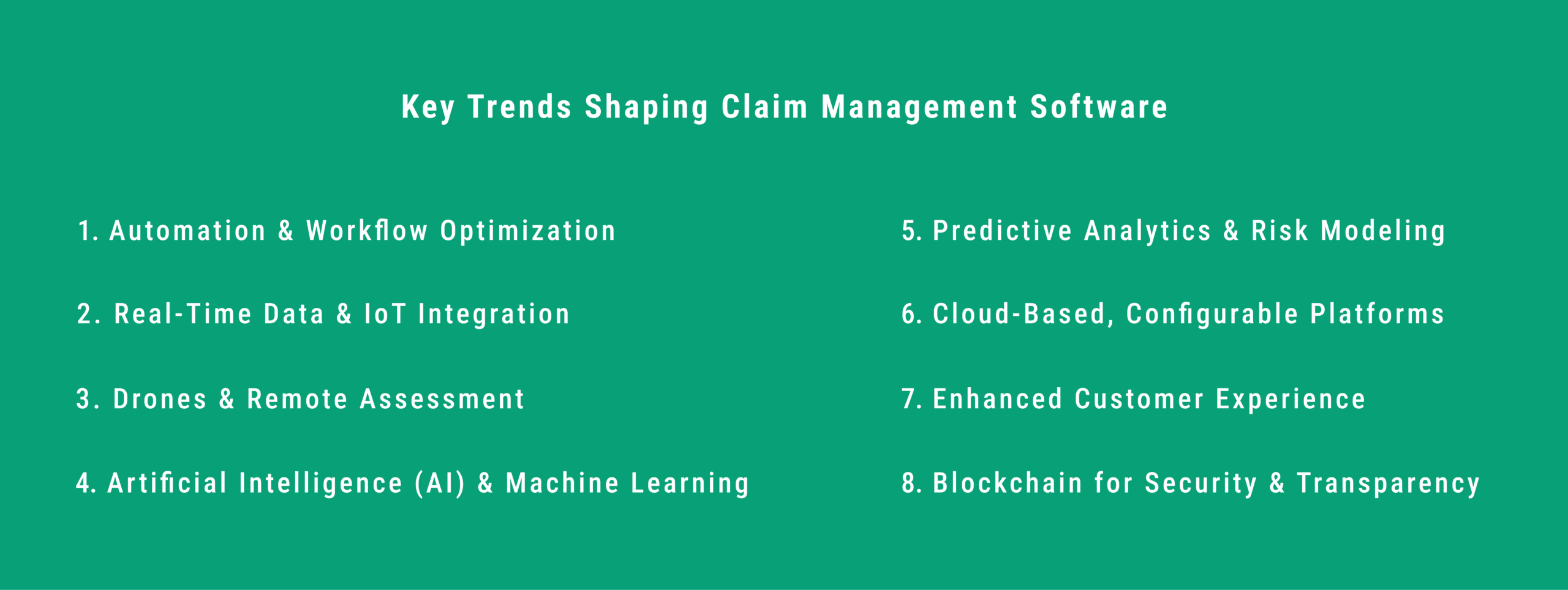
Key Trends Shaping Claim Management Software
-
Automation & Workflow Optimization:
AI and machine learning are revolutionizing the claims process. Modern claim management software can now analyze vast datasets, detect fraud, and predict claim outcomes with remarkable accuracy. For example, AI-driven systems can spot patterns in claims data, flag suspicious activity, and even forecast repair costs, enabling faster and more informed decisions.
-
Real-Time Data & IoT Integration:
Automation is streamlining every stage of claim handling—from first lodgment to final settlement. Routine tasks like data entry, document processing, and triage are now managed by intelligent bots, freeing up human experts for complex cases. This not only reduces processing times but also minimizes human error and operational costs.
-
Drones & Remote Assessment:
The Internet of Things (IoT) is transforming risk assessment and claims validation. Smart sensors in buildings can detect leaks, fires, or structural issues and instantly transmit data to insurers. This real-time information accelerates claims resolution and empowers builders to proactively manage risks, reducing both claim frequency and severity.
-
Artificial Intelligence (AI) & Machine Learning:
Drones are now a standard tool for post-disaster assessment, especially after storms or bushfires. They provide high-resolution imagery and video, allowing insurers and builders to evaluate damage quickly and safely—often reducing claim cycle times from weeks to days.
-
Predictive Analytics & Risk Modeling:
By using historical data, market trends, and customer behavior, predictive analytics within claim management software helps insurers and builders expect claim surges, allocate resources, and set more accurate premiums. This proactive approach is key to maintaining profitability in a volatile market.
-
Cloud-Based, Configurable Platforms:
Modern solutions are cloud-based, ensuring secure, anytime-anywhere access. Configurable workflows mean the software adapts to the unique needs of each builder or insurer, not the other way around. This flexibility is crucial for scaling during catastrophe events or customizing for different regulatory requirements.
-
Enhanced Customer Experience:
Today’s policyholders expect digital-first, transparent interactions. Leading claim management software enables self-service portals, real-time claim tracking, and instant document uploads—boosting satisfaction and loyalty.
-
Blockchain for Security & Transparency:
Blockchain technology is emerging in the insurance space for its ability to create tamper-proof records, streamline verification, and reduce fraud. This is particularly valuable for high-value construction claims, where trust and accuracy are paramount.
Latest Challenges for Australian Insurance Builders
-
Catastrophe Claims Surge:
The 2022-2024 period saw record-breaking claims from floods and storms, overwhelming traditional processes.
-
Labour Shortages:
Skilled trades are in short supply, making rapid assessment and resource allocation critical.
-
Regulatory Pressure:
Compliance with evolving data privacy and reporting standards is non-negotiable, especially for large-scale builders handling sensitive client data.
-
Customer Expectations:
Builders are expected to deliver not just repairs, but seamless, transparent communication throughout the claims journey.
Innovations in Action: ClaimBuild by Velit Solutions
ClaimBuild, from Velit Solutions, exemplifies the future of claim management software for Australian insurance builders and construction professionals.
Here’s how:
-
End-to-End Automation:
From first notice of loss to final settlement, ClaimBuild automates routine processes, ensuring nothing falls through the cracks.
-
Integrated Communication:
All stakeholders—insurers, builders, loss adjusters, and customers—collaborate on a single platform, eliminating email chains and miscommunication.
-
Customizable Workflows:
Builders can tailor the system to match their specific processes, ensuring compliance and efficiency.
-
Mobile & Remote Access:
Field teams can upload photos, documents, and updates directly from job sites, speeding up approvals and reducing downtime.
-
Data Security & Compliance:
Robust encryption, audit trails, and compliance tools help meet Australia’s strict regulatory standards.
The Road Ahead: What to Expect
The future of claim management software is bright, but it demands continuous innovation.
Expect to see:
- Wider adoption of AI and predictive analytics for even faster, more accurate claims.
- Greater integration with IoT devices and telematics for real-time risk management.
- Expansion of blockchain for end-to-end transparency and fraud prevention.
- More intuitive, user-friendly interfaces for both builders and policyholders.
Final Thoughts
For Australian insurance builders and the construction industry, embracing advanced claim management software is no longer optional—it’s essential for survival and growth. As climate risks intensify and customer expectations rise, those who invest in the latest technologies will be best positioned to deliver rapid, reliable, and transparent claim outcomes.
By using solutions like ClaimBuild, builders can turn today’s challenges into tomorrow’s opportunities—streamlining operations, delighting customers, and staying ahead of the competition.
Ready to future-proof your claims process? Now is the time to invest in the next generation of claim management software.
Find Out More About Future!
How Claim Management Software Enhances Efficiency for Insurance Builders
Why Australian Construction Businesses Need Claim Management Software in 2025
How Claim Management Software Improves Customer Experience in the Australian Construction Industry
Australia’s construction and insurance sectors are facing unprecedented challenges: rising claim volumes from severe weather events, pressure to accelerate repairs, and the ongoing demand for transparency and compliance. For insurance builders, these hurdles can slow down operations, increase costs, and customer satisfaction. Enter claim management software—a transformative solution helping leading Australian insurance builders streamline their processes, reduce risk, and deliver better outcomes.
The Australian Insurance Builder Landscape: Current Challenges
In recent years, Australia has experienced a surge in catastrophic weather events, including bushfires, floods, and storms. According to the Insurance Council of Australia, insured losses from natural disasters exceeded $5 billion in 2023 alone. This spike in claims has put immense pressure on insurance builders to manage high volumes efficiently, compliance, and ensure quality repairs.
Key challenges faced by insurance builders today include:
- Managing large volumes of claims and documentation
- Ensuring compliance with evolving regulations and insurance standards
- Coordinating multiple stakeholders
- Meeting customer expectations for faster, transparent service
- Reducing administrative overhead and manual data entry
What Is Claim Management Software?
Claim management software is a digital platform designed to automate and streamline the end-to-end process of handling insurance claims. From first lodgment and assessment to repair management and final settlement, these solutions centralize information, automate workflows, and provide real-time visibility for all stakeholders.
Modern platforms, such as ClaimBuild by VELIT Solutions, are tailored specifically for the Australian market, addressing the unique needs of insurance builders and the construction industry.
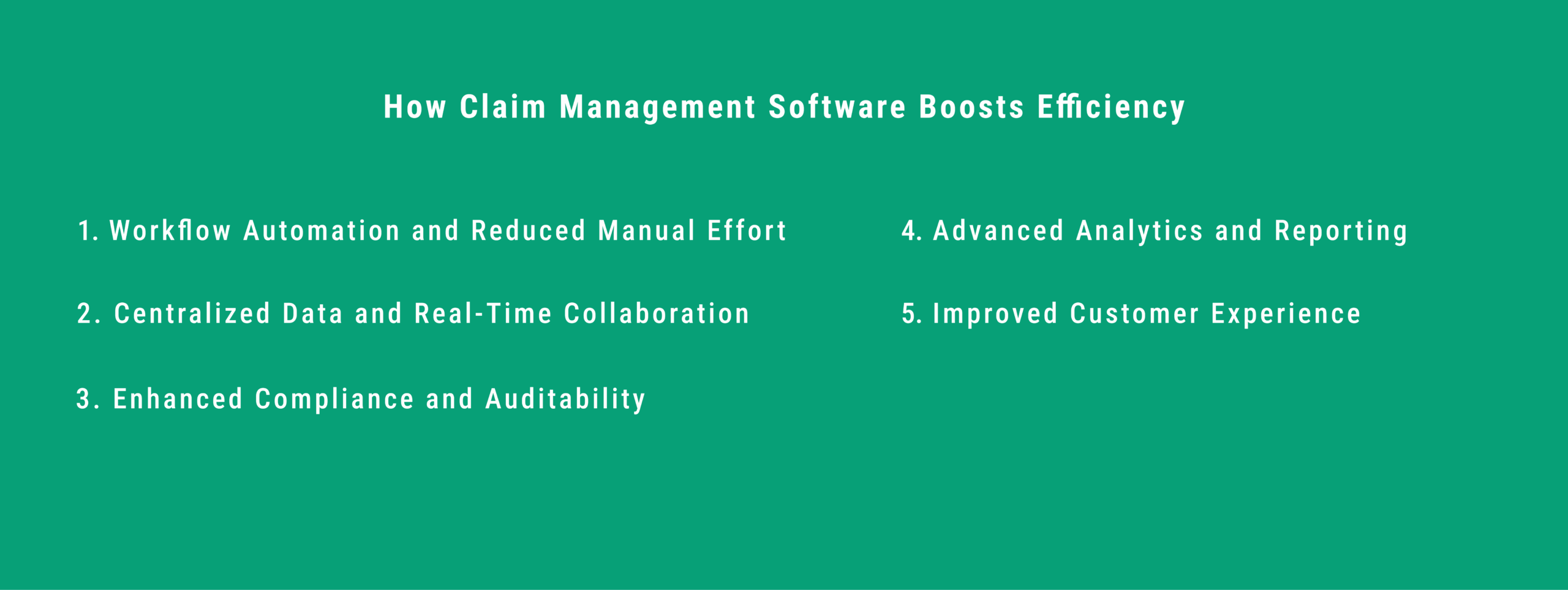
How Claim Management Software Boosts Efficiency
1. Workflow Automation and Reduced Manual Effort
Traditional claims processing is often bogged down by paperwork, manual data entry, and repetitive tasks.
Claim management software automates these processes, allowing insurance builders to:
- Automatically assign tasks to the right team members
- Trigger notifications and reminders for key milestones
- Digitally collect and store all claim-related documents and photos
- Generate and send standardized reports and communications
This automation significantly reduces human error and staff to focus on higher-value tasks.
2. Centralized Data and Real-Time Collaboration
With claim management software, all claim information—photos, reports, quotes, communications—is stored in a secure, centralized platform.
- Instant access to up-to-date claim status for all stakeholders
- Real-time collaboration between builders, insurers, and trades
- Faster decision-making and approvals
VELIT Solutions’ ClaimBuild, for example, offers a cloud-based portal that connects all parties, ensuring everyone has the latest information at their fingertips.
3. Enhanced Compliance and Auditability
Regulatory compliance is a top concern in Australia’s insurance sector.
Claim management software helps insurance builders:
- Maintain detailed audit trails of all actions and communications
- Ensure data security with role-based access controls
- Automatically generate compliance reports and documentation
This not only reduces the risk of non-compliance but also simplifies audits and regulatory checks.
4. Advanced Analytics and Reporting
Data-driven insights are critical for continuous improvement.
Claim management software provides:
- Customizable dashboards to monitor KPIs (e.g., average claim cycle time, cost per claim)
- Automated generation of performance and compliance reports
- Predictive analytics to bottlenecks and forecast resource needs
These features empower insurance builders to operations and improve service delivery.
5. Improved Customer Experience
Today’s policyholders expect transparency, speed, and clear communication.
Claim management software enables insurance builders to:
- Provide customers with real-time updates on claim progress
- Offer digital self-service options for document uploads and status checks
- Reduce claim resolution times, leading to higher satisfaction
Research shows that insurers using advanced claims solutions report up to 30% faster claim resolutions and significant improvements in customer satisfaction scores.
Latest Trends in Australian Claim Management
- AI and Automation: Leading platforms now incorporate artificial intelligence to automate document recognition, fraud detection, and even damage assessment.
- Mobile Access: Builders and can upload photos, complete checklists, and update claim statuses directly from the field.
- Integration with Insurer Systems: Seamless data exchange with insurer platforms reduces double-handling and accelerates approvals.
Case Study: ClaimBuild by VELIT Solutions
ClaimBuild is a purpose-built claim management software solution for Australian insurance builders.
Key features include:
- End-to-end claim lifecycle management, from lodgment to completion
- Automated workflow assignment and progress tracking
- Secure document and photo storage
- Integrated communication tools for all stakeholders
- Real-time dashboards and customizable reporting
Builders using ClaimBuild have reported reductions in claim cycle times, improved compliance, and a measurable boost in customer satisfaction.
Addressing the Problems of Today—and Tomorrow
As claim volumes rise and customer expectations grow, the old ways of managing insurance repairs are no longer sustainable.
Claim management software is not just a tool for efficiency—it’s a strategic asset that enables insurance builders to:
- Scale operations without increasing headcount
- Respond quickly to surges in demand after natural disasters
- Maintain a competitive edge in a rapidly evolving market
Conclusion
The future of insurance building in Australia is digital, data-driven, and customer-centric. By adopting advanced claim management software, insurance builders can overcome today’s challenges, deliver superior service, and position themselves for long-term success.
If your business is ready to streamline operations, enhance compliance, and delight customers, now is the time to invest in a robust claim management software solution like ClaimBuild.
Read More Articles On!
Manual vs. Automated Claims: Why Claim Management Software Wins
5 Signs It’s Time to Upgrade Your Claim Management Software
Best Claim Management Software Solutions for 2025: Empowering the Australian Construction Industry
Australia’s construction industry evolves fast. Tighter deadlines, stricter compliance, and complex projects demand efficient claims management for 2025 success—from minor renovations to multi-million-dollar commercial builds.
Claim management software solves this. Builders, subcontractors, quantity surveyors, and managers across Australia use tools like ClaimBuild by Velit Solutions. They cut delays, reduce risks, and boost project efficiency.
What Is Claim Management Software for Construction?
Claim management software is designed to automate and streamline the end-to-end process of handling project-related claims. These could include variation claims, delay claims, extension of time requests, defect rectification notices, or insurance-related disputes tied to building work.
Instead of dealing with spreadsheets, scattered email threads, or manual paperwork, construction teams can manage all claims in a centralised digital platform. ClaimBuild, for example, is tailored specifically for the building and construction sector, helping Australian businesses stay on track while protecting project profitability.
Why the Construction Industry in Australia Needs This in 2025
From changes to the Security of Payment Act to tighter building codes and increasing subcontractor demands, the pressure is on.
Here’s why software like ClaimBuild is critical for the modern Australian construction firm:
Streamlined Project Claim Processing
Whether you’re building townhouses in Melbourne or commercial fit-outs in Sydney, construction projects are complete with moving parts. Scope changes, delays, material cost fluctuations, or on-site incidents often lead to claims.
Claim management software let’s you:
- Log claims directly on-site via mobile or tablet
- Attach supporting documents (photos, delivery notes, contracts)
- Assign responsibility to relevant parties (QS, project managers)
- Track the claim status in real-time
ClaimBuild automates this entire process—cutting out bottlenecks and getting approvals or disputes sorted faster.
Centralised Data & Smart Reporting
Every claim filed on a job site has the potential to impact your cash flow and delivery schedule. With software like ClaimBuild, all data is stored in a central dashboard,
giving construction managers and directors real-time visibility into:
- Total open and resolved claims
- Financial value at risk
- Subcontractor performance
- Claim turnaround times
You can generate custom reports for internal reviews, client updates, or legal preparation—no more digging through email chains or job folders.
Built for Australian Regulations & Contracts
In Australia, construction claims are tightly tied to contractual frameworks—whether it’s AS4000, AS2124, HIA, or ABIC. Missing a deadline for a variation or not submitting the proper documentation can mean losing out on legitimate entitlements.
ClaimBuild is tailored to suit the Australian construction contract landscape. It:
- Tracks critical claim submission deadlines
- Logs time-stamped evidence
- Maintains audit trails in line with state-specific SOP Acts
Whether you’re working under NSW’s Security of Payment Act or Victoria’s contractual guidelines, the system keeps your claims process compliant.
Seamless Collaboration Between Office & Site
Construction teams are rarely in one place. With teams spread across head offices, job sites, and suppliers, miscommunication is common.
ClaimBuild bridges this gap by allowing:
- Site supervisors to lodge claims from mobile
- QS or contract admin teams to review and escalate claims in real-time
- Directors to sign off from anywhere via cloud-based access
Everyone stays on the same page—no duplication, no lost documents, no confusion.
Data Security & Legal Backup
Construction disputes can escalate quickly—and without a solid trail of evidence, it’s easy to lose out. That’s why ClaimBuild includes secure cloud storage, automatic backups, and user access controls.
All submitted claims, communications, and attachments are stored securely and can be used as legal evidence in dispute resolution, adjudication, or court proceedings.
Minimise Risk, Maximise Profitability
Claim mismanagement leads to:
- Missed payments
- Extended project delays
- Damaged client relationships
- Unrecoverable costs
ClaimBuild helps builders and project teams capture every entitlement on time, resolve disputes faster, and reduce financial leakage on large jobs. That means better margins, tighter timelines, and fewer surprises.
Real-World Use Cases in Australian Construction
Here’s how ClaimBuild fits into real scenarios across the country:
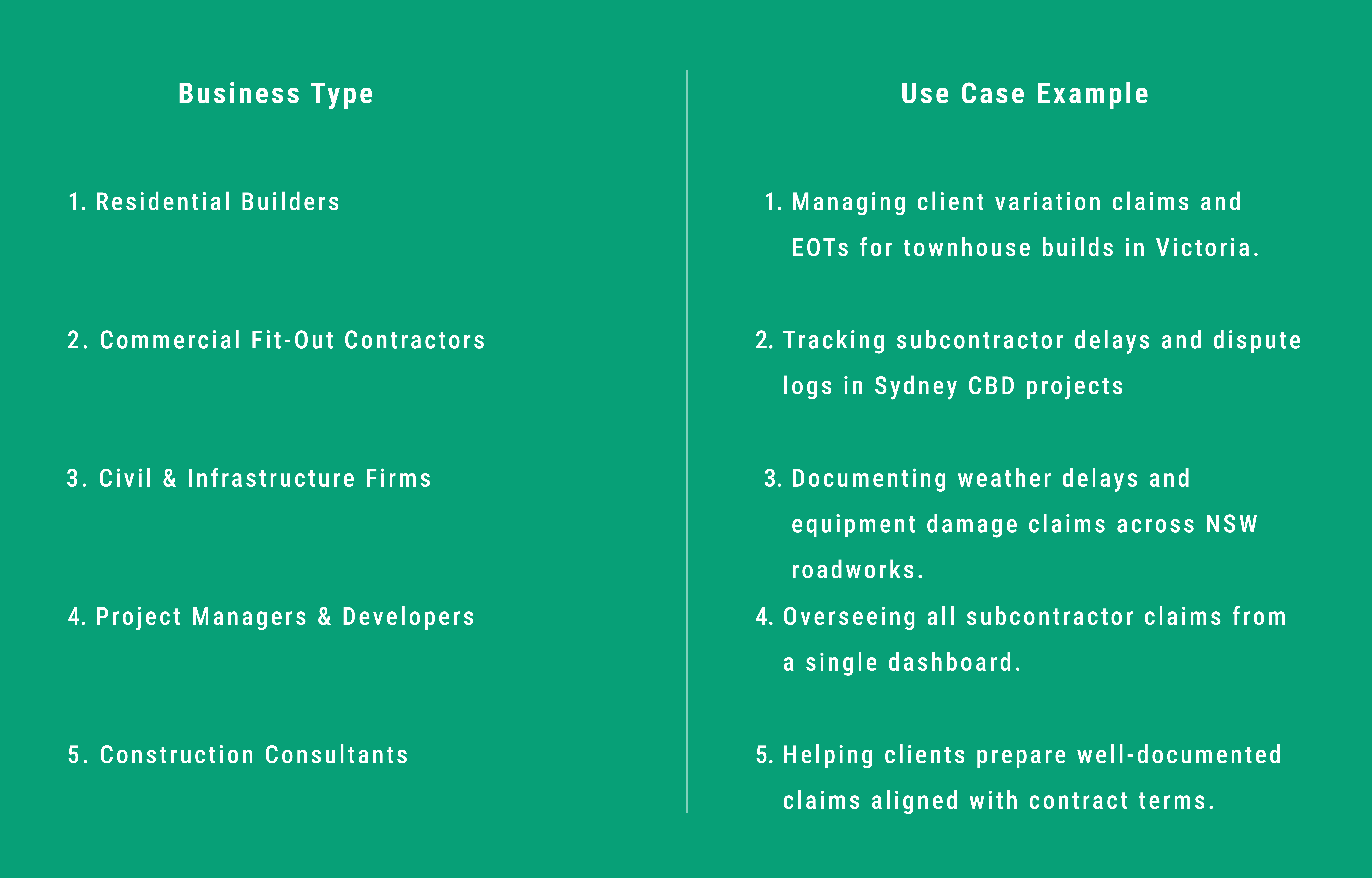
Why Choose ClaimBuild for Your Construction Business?
ClaimBuild isn’t a generic claims tool—it’s built specifically for the construction industry. Its workflows align with Australian building contracts, and its user interface is designed for builders, estimators, QS teams, and site supervisors alike.
Key advantages:
- Mobile-friendly for job site teams
- Built-in document templates for variations, delays, and defects
- Integration with tools like Procore, MYOB, and Xero
- Local Australian support and training available
Whether you’re running two jobs or managing a $100M pipeline, ClaimBuild can scale with your business.
Ready to Protect Your Profits and Projects?
Don’t leave your claims to chance. Whether you’re handling five variations a week or 50, a digital system like ClaimBuild can keep your projects running smoothly and your payments flowing.
Book a free demo customised for Australian construction businesses
Let us show you how you can manage claims smarter, faster, and with fewer headaches in 2025.
Read more Articles on claim management software:
How Claim Management Software Improves Customer Experience in the Australian Construction Industry
What Is Claim Management Software & How Does It Work?
Top 10 Features to Look for in Claim Management Software
In the fast-paced world of Australian construction and building, managing claims efficiently is crucial-not just for compliance and risk mitigation, but for delivering a seamless customer experience. As projects grow in complexity and the volume of claims increases, traditional manual processes often lead to delays, errors, and frustration for everyone involved. This is where claim management software is transforming the industry, offering a smarter, faster, and more customer-centric approach.
Why Customer Experience Matters in Claims Management
Customer experience is at the heart of every successful construction business. When a claim arises-whether it’s related to defects, insurance, or contractual disputes-how quickly and transparently it’s handled can make or break a client’s trust. In Australia, where the construction sector is a significant driver of the economy, ensuring that claims are resolved efficiently is not just a matter of operational excellence but a competitive advantage.
The Role of Claim Management Software
Claim management software is designed to automate, streamline, and enhance every step of the claims process. For the Australian construction and building industry, products like ClaimBuild by VELIT Solutions offer tailored features that address local regulatory requirements, industry standards, and unique project workflows.
Key Benefits for Australian Construction Businesses
- Faster Claim Resolution: Automated workflows and digital document management mean claims are processed up to 70% faster compared to manual methods. This speed reduces downtime, accelerates project timelines, and keeps clients informed every step of the way.
- Improved Accuracy and Reduced Errors: Advanced claim management software uses data validation and business rules to minimize human error. According to McKinsey, automation can reduce claim errors by up to 90%.
- Real-Time Updates and Transparency: Modern platforms provide real-time status updates and self-service portals, meeting the expectations of 92% of customers who want instant access to claim progress.
- Lower Operational Costs: Automation streamlines repetitive tasks, reducing the need for manual intervention and cutting operational costs by up to 30%.
- Enhanced Data Security and Compliance: Australian construction firms must comply with strict data privacy and reporting regulations. Claim management software centralizes data, ensures audit trails, and supports compliance with local laws.
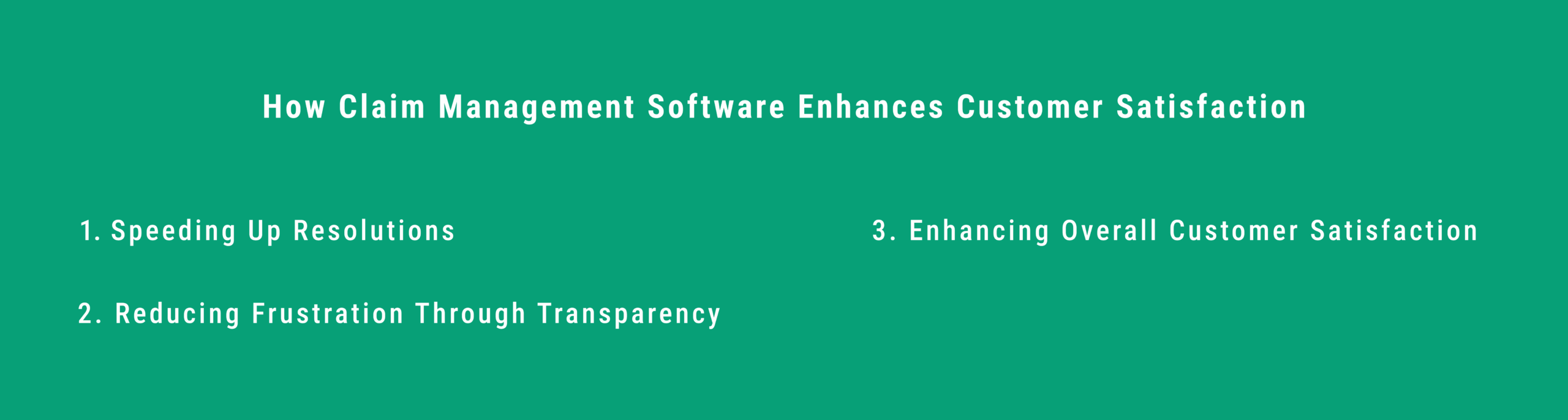
How Claim Management Software Enhances Customer Satisfaction
1. Speeding Up Resolutions
Delays in claim processing are a major source of frustration for clients. By automating data entry, document collection, and approval workflows, claim management software dramatically shortens turnaround times. For example, Zurich Australia reported up to a 45-day reduction in claim processing time after implementing a modern claim management solution. This efficiency ensures that clients receive resolutions, boosting satisfaction and loyalty.
2. Reducing Frustration Through Transparency
One of the biggest pain points in traditional claim processes is the lack of visibility. Clients are often left in the dark, unsure of the status of their claims or the next steps.
Claim management software solves this by offering:
- Customer Portals: Clients can log in at any time to check the status of their claim, upload documents, or communicate with the claims team.
- Automated Notifications: Automated Notifications: Instant alerts keep clients informed about updates, approvals, or requests for additional information.
- Centralized Communication: All correspondence is tracked within the platform, reducing miscommunication and lost emails.
3. Enhancing Overall Customer Satisfaction
By delivering faster resolutions and transparent communication, claim management software directly improves the customer experience. According to Accenture, 55% of customers would switch to a provider that offers faster claim processing. In the competitive Australian construction market, this can be a decisive factor in winning repeat business and positive referrals.
Real-World Impact: The Australian Construction Industry
The Australian construction sector faces unique challenges-complex projects, multiple stakeholders, and stringent regulations. Claim management software tailored for this industry, like ClaimBuild,
offers:
- Customizable Workflows: Adapt to different claim types, project sizes, and compliance requirements.
- Scalable Data Management: Handle large volumes of claims and supporting documents without losing efficiency.
- Integrated Reporting: Generate real-time reports for internal analysis and regulatory compliance, enabling proactive risk management.
Case Study: Zurich Australia
Zurich Australia’s adoption of cloud-based claim management software led to significant improvements in customer service. With a modern, claimant-centric approach, Zurich’s claims team could focus more on customer interactions and less on administrative tasks, resulting in higher levels of client satisfaction and operational efficiency.
Why Australian Construction Firms Should Invest in Claim Management Software
- Competitive Edge: Offer superior customer service and faster resolutions compared to competitors still reliant on manual processes.
- Risk Mitigation: Proactively identify and address risks before they escalate, protecting both the business and its clients.
- Future proofing: As the industry evolves, digital platforms ensure your business can scale and adapt to new challenges and opportunities.
Conclusion
In today’s digital age, claim management software is no longer a luxury-it’s a necessity for Australian construction and building companies that want to deliver exceptional customer experiences. By speeding up resolutions, reducing frustration, and enhancing satisfaction, these platforms are setting new standards for efficiency and transparency in the industry.
Investing in claim management software like ClaimBuild is not just about streamlining operations; it’s about building lasting client relationships, earning trust, and securing your place as a leader in the Australian construction market.
Read More News
The Future of Claim Management Software: Trends & Innovations
Claim management software is transforming the way the construction and building industry in Australia handles claims, making the process more efficient, transparent, and less prone to errors. In this blog, we will explore what claim management software is, how it works, and why it is becoming essential for construction businesses, with a particular focus on the innovative solution offered by Velit Solutions through their product ClaimBuild.
What Is Claim Management Software?
Claim management software transforms claims handling in Australia’s construction industry. It makes processes efficient, transparent, and error-free.
Velit Solutions’ ClaimBuild leads this change. It automates the full claims process, from submission to settlement. Teams centralize data, manage workflows, and access real-time reports.
Unlike spreadsheets, ClaimBuild cuts errors. It speeds up resolutions. For instance, contractors, subcontractors, and clients collaborate seamlessly.
How Does Claim Management Software Work?
Claim management software digitizes the claims lifecycle. It automates key steps. Here’s how:
- Claims Intake: Users submit claims via web, mobile, or email. The system captures details accurately from the start.
- Automated Workflows: ClaimBuild routes claims instantly. It assigns tasks for investigation, approval, and payment. This cuts delays.
- Document Management: Store photos, reports, and contracts securely. Retrieve them easily for audits.
- Real-Time Tracking: Stakeholders monitor progress. They get alerts and chat in-app. Additionally, this boosts collaboration.
- Analytics: Spot trends and fraud with dashboards. Optimize resources effectively.
- Integrations: Link to CRM or billing systems. Ensure smooth data flow.
Why ClaimBuild Is a Game-Changer?
Velit Solutions’ ClaimBuild is an innovative claim management software tailored specifically for the construction and building industry in Australia. It addresses the unique challenges faced by construction firms managing complex claims related to contracts, variations, delays, and disputes.
Key Features of ClaimBuild:
- End-to-End Claim Lifecycle Management: ClaimBuild supports the entire claims process from notification to settlement, ensuring no step is overlooked.
- Customizable Workflows: The software adapts to your company’s specific processes, enabling efficient handling of claims in compliance with Australian construction regulations.
- Robust Document Control: ClaimBuild offers secure storage and easy retrieval of all claim-related documents, including digital attachments and correspondence.
- Collaborative Platform: It eases communication among project managers, contractors, and legal teams, reducing misunderstandings and speeding up resolution.
- Real-Time Reporting: Users gain access to dashboards and reports that provide insights into claim statuses, financial impacts, and risk areas.
- Compliance and Audit Ready: The system maintains detailed audit trails, helping firms meet regulatory requirements and prepare for disputes or litigation.
By leveraging ClaimBuild, Australian construction companies can automate up to 80% of their claims processing tasks, significantly reduce administrative overhead, and improve accuracy and transparency in managing claims.
Current Trends and News in Claim Management Software
The claim management software landscape is rapidly evolving with several notable trends changing the construction sector:
- Automation and Artificial Intelligence: The growing adoption of AI-powered analytics and automated processes is allowing for quicker identification of suspicious claims and potential fraud, minimizing losses and enhancing overall results.
- Cloud-Based Solutions: Cloud platforms like ClaimBuild offer scalability, remote access, and seamless updates, which are critical for construction projects spread across multiple sites.
- Mobile Accessibility: Mobile forms and apps allow field teams to submit claims and documentation instantly, speeding up data capture and reducing errors.
- Integration with Project Management Tools: Integration with construction project management software enhances data sharing and coordination, improving overall project delivery and claims handling.
- Focus on Customer Experience: Transparent claim processes and prompt communication foster trust and long-term client relationships, an increasingly important factor in competitive markets.
FAQs About ClaimBuild for Australian Construction Industry
Q1: How does ClaimBuild improve claims handling for Australian construction companies?
ClaimBuild streamlines the entire claims lifecycle with automated workflows, real-time tracking, and robust document management tailored to Australian construction regulations. This reduces processing time, minimizes errors, and improves collaboration among stakeholders.
Q2: Can ClaimBuild integrate with other construction management software?
Yes, ClaimBuild is designed to integrate seamlessly with other project management and financial systems, ensuring consistent data flow and eliminating duplicate data entry.
Q3: Is ClaimBuild compliant with Australian construction industry standards?
Absolutely. ClaimBuild incorporates compliance features and audit trails that align with Australian legal and regulatory requirements, helping firms stay audit-ready and manage disputes effectively.
Conclusion,
Claim management software like Velit Solutions’ ClaimBuild is revolutionizing how the Australian construction and building industry manages claims. By automating workflows, enhancing transparency, and offering actionable insights, it empowers firms to resolve claims faster, reduce costs, and keep strong stakeholder relationships. For construction companies aiming to stay competitive and compliant, investing in a robust claim management solution is no longer optional but essential.
Read More Articles:
How to Choose the Right Claim Management Software for Your Business
Best Practices for Implementing Claim Management Software in the Australian Construction Industry
5 Signs It’s Time to Upgrade Your Claim Management Software
Claim management software is transforming the way the Australian construction and building industry handles claims, disputes, and project variations. As the sector faces mounting pressure from rising project complexity, regulatory changes, and tighter margins, adopting the right claim management software can make a significant difference in efficiency, accuracy, and customer satisfaction. This blog explores the top 10 must-have features to look for—using Velit Solution’s ClaimBuild as a benchmark—so you can streamline claims, boost accuracy, and improve your bottom line.
Why Claim Management Software Matters in Australia’s Construction Industry
Australia’s construction sector is experiencing a surge in disputes and claims, driven by factors such as supply chain disruptions, labor shortages, and evolving regulatory requirements. Manual claim processes are often slow, error-prone, and lack transparency, leading to delayed settlements and strained client relationships. According to industry insights, automated claim management can enhance accuracy by 30% and boost productivity by up to 80%. The right claim management software addresses these challenges by automating workflows, improving data access, and ensuring compliance.
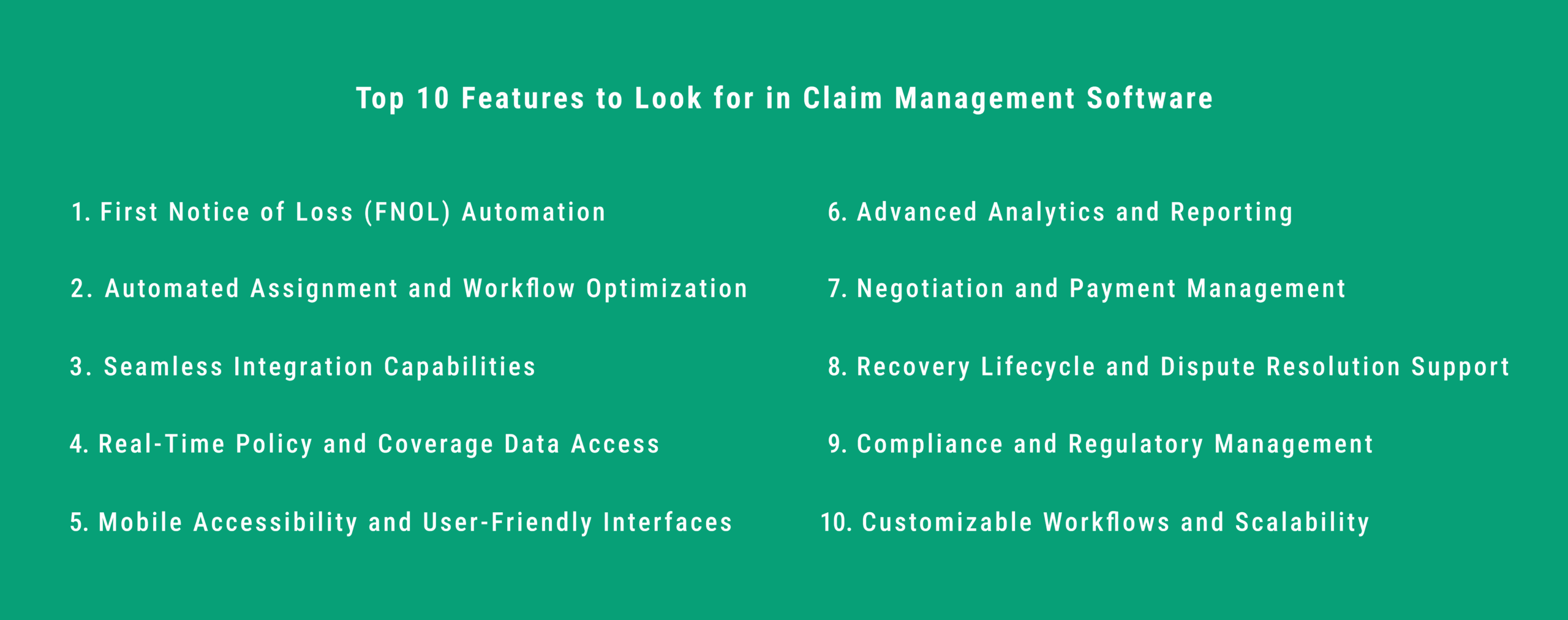
Top 10 Features to Look for in Claim Management Software
1. First Notice of Loss (FNOL) Automation
Efficient claim management starts with capturing the first notice of loss quickly and accurately. Look for software that allows dynamic Q&A sessions, predictive modeling, and omnichannel support (phone, email, web) to minimize manual intervention and speed up the process.
2. Automated Assignment and Workflow Optimization
Automated task assignment ensures claims are routed to the right personnel based on skills, workload, and claim type. This reduces bottlenecks and ensures consistent handling, especially in complex construction projects where multiple parties are involved.
3. Seamless Integration Capabilities
Your claim management software should integrate with third-party systems such as project management tools, CRMs, and financial software. This eliminates manual data entry, reduces errors, and improves operational efficiency.
4. Real-Time Policy and Coverage Data Access
Instant access to policy and coverage details-including limits, deductibles, and impacted coverage-enables faster and more accurate claim assessment. This is crucial for the construction industry, where project scopes and contracts can be highly variable.
5. Mobile Accessibility and User-Friendly Interfaces
Modern solutions offer mobile apps and intuitive interfaces, allowing users to submit and track claims from anywhere ideal for construction professionals often on-site or on the move.
6. Advanced Analytics and Reporting
Robust analytics and reporting features provide real-time dashboards, customizable reports, and trend analysis. This helps identify bottlenecks, track KPIs, and refine the entire claims process for better outcomes.
7. Negotiation and Payment Management
Look for software that streamlines negotiation and payment workflows, with built-in authorization rules and escalation paths. This reduces delays and ensures payments are handled securely and compliantly.
8. Recovery Lifecycle and Dispute Resolution Support
Effective claim management software supports the full recovery lifecycle-identifying opportunities, automating referrals, and managing disputes or variations proactively. This is particularly valuable in the construction sector, where claims can be complex and multi-faceted.
9. Compliance and Regulatory Management
Australian construction companies face strict compliance requirements. The software should help track regulatory changes, ensure documentation is up-to-date, and provide audit trails for every claim, reducing legal risks.
10. Customizable Workflows and Scalability
Every construction business is unique. The best claim management software offers customizable workflows and scales with your business as it grows, adapting to new project types, contract models, and regulatory requirements.
How ClaimBuild by Velit Solutions Stands Out
ClaimBuild is designed specifically for the Australian construction and building industry. It addresses the unique challenges faced by local businesses-such as compliance with Australian standards, integration with popular construction management platforms, and support for multi-party claims. With features like automated FNOL, real-time analytics, and seamless mobile access, ClaimBuild empowers construction professionals to manage claims efficiently, reduce disputes, and keep strong client relationships.
Problems Facing Australian Construction Professionals:
- Manual Processing Delays: Paper-based or spreadsheet-driven claim management leads to errors and slow settlements.
- Lack of Transparency: Without centralized software, tracking claim status and communication becomes fragmented.
- Regulatory Complexity: Navigating evolving Australian regulations manually increases compliance risks.
- Data Silos: Disconnected systems make it difficult to access project, contract, and insurance data in one place.
- Customer Dissatisfaction: Delayed or inaccurate claims erode trust and damage reputations.
Automated claim management can reduce processing times by up to 50%, directly impacting project profitability and client satisfaction.
Trending Topics in Claim Management Software
- AI and Predictive Analytics: AI-driven claim triage and fraud detection are becoming standard, helping companies make faster, data-driven decisions.
- Cloud-Based SaaS Solutions: Cloud deployment offers scalability, security, and remote access-critical for distributed construction teams.
- Mobile-First Design: Mobile apps and responsive interfaces are now expected, enabling on-site claim submissions and real-time updates.
- Integration with Construction ERPs: Seamless data flow between claim management and core construction systems is a growing requirement.
FAQs
Q1: How does ClaimBuild help Australian construction companies comply with local regulations?
ClaimBuild is tailored for the Australian market, ensuring all claim documentation, workflows, and audit trails meet local regulatory standards. Its compliance management features help businesses stay up to date with changing laws and reduce legal risks.
Q2: Can ClaimBuild integrate with our existing project management and accounting software?
Yes, ClaimBuild offers robust integration capabilities, allowing seamless data exchange with popular construction project management and accounting platforms. This streamlines workflows and eliminates manual data entry.
Q3: What makes ClaimBuild different from generic claim management software for the construction industry?
ClaimBuild is purpose-built for the construction and building sector in Australia, with features like automated FNOL, customizable workflows, and support for multi-party claims. Its mobile accessibility and real-time analytics make it ideal for fast-paced project environments.
Conclusion
Choosing the right claim management software is essential for Australian construction companies aiming to streamline claims, enhance accuracy, and boost customer satisfaction. By focusing on these top 10 features—automation, integration, analytics, compliance, and more—you can future-proof your business and drive better outcomes for every project. ClaimBuild by Velit Solutions stands out as a leading choice, purpose-built for the unique challenges of the Australian construction and building industry.
Find the must-have features in claim management software to streamline claims, enhance accuracy, boost customer satisfaction and your bottom line.
Explore More Arcticles:
Manual vs. Automated Claims: Why Claim Management Software Wins
The Future of Claim Management Software: Trends & Innovations
The Australian insurance building and construction industry is facing a period of rapid change. With rising claim volumes, complex regulatory requirements, and higher customer expectations for speed and transparency, the need for efficient claim management software has never been greater. In this blog, we’ll explore how to select the right solution for your business, highlight the latest industry challenges, and spotlight key features to look for—using the innovative ClaimBuild platform by Velit Solutions as an example.
Why Claim Management Software Matters in 2025
The insurance sector in Australia is under pressure.
Builders and insurers are dealing with:
- Increased frequency of severe weather events causing more property damage claims.
- Stricter compliance standards from regulators.
- Labour shortages and rising operational costs.
- Customers demand faster, more transparent claim resolutions.
Manual claims processing is no longer sustainable. Industry data shows that modern claim management software can automate up to 80% of repetitive tasks, slash processing times by up to 40%, and improve customer satisfaction by 20%. For Australian insurance builders, this means more jobs completed, fewer errors, and happier clients.
Key Features to Look for in Claim Management Software
Not all claim management software is created equal.
Here are essential features you should prioritize:
- Automated Workflows: Streamline every step from claim intake to settlement, reducing manual data entry and human error.
- Real-Time Document Management: Centralize all claim-related documents for instant access and improved collaboration.
- Integration Capabilities: Seamlessly connect with your existing policy, billing, and CRM systems for a unified workflow.
- Advanced Analytics: Detect fraud, refine resources, and gain actionable insights to drive business decisions.
- Self-Service Portals: Empower customers and contractors to submit and track claims online, boosting transpare
- Scalability: Ensure the system can handle peak claim periods without performance issues.
The Latest Industry Challenges
Australian insurance builders are currently grappling with:
- Extreme Weather Events: Floods and storms are increasing claim volumes, making speed and accuracy critical.
- Labour Shortages: Skilled adjusters are in short supply, so automation is essential to keep service levels.
- Rising Fraud Risks: Sophisticated fraud schemes require advanced analytics for early detection.
- Customer Expectations: Policyholders want digital-first experiences—fast, transparent, and mobile-friendly.
Choosing the right claim management software directly addresses these pain points by automating processes, improving accuracy, and delivering the digital experience today’s customers expect.
Spotlight: ClaimBuild by Velit Solutions
ClaimBuild is a purpose-built claim management software designed specifically for the Australian insurance building and construction sector.
Here’s how it stands out:
- End-to-End Automation: From first claim lodgment to final settlement, every step is automated for maximum efficiency.
- Custom Workflows: Tailored to the unique needs of builders, insurers, and loss adjusters.
- Real-Time Collaboration: Enables all stakeholders—builders, insurers, and clients—to work together on a single platform.
- Compliance Assurance: Keeps you up to date with the latest Australian regulatory changes.
- Data-Driven Insights: Advanced reporting and analytics help you identify trends, reduce fraud, and refine your business.
Making the Right Choice
When selecting claim management software,
consider:
- Your business size and claim volume.
- Integration needs with existing systems.
- Regulatory requirements specific to Australian insurance and construction.
- The level of automation and analytics needed.
- User experience for both staff and customers.
A solution like ClaimBuild offers all these features, helping you stay competitive, compliant, and customer-focused in a challenging market.
Conclusion
The right claim management software is more than just a digital tool—it’s a strategic asset that can transform your business. For Australian insurance builders and construction professionals, investing in a robust platform like ClaimBuild means faster claims, lower costs, and a superior customer experience. In 2025’s fast-moving insurance landscape, that’s a competitive edge you can’t afford to miss.
Read More Now!
How Construction Management Software Helps Prevent Cost Overruns
Why General Contractors Are Switching to Construction Management Software